Drone LiDAR Surveys & Terrain Modelling Across Victoria

Survey-grade ground and terrain data — delivered faster than traditional methods.

When your project depends on accurate elevation data, ground contours, or terrain analysis, you can’t afford uncertainty. Storm Spatial’s drone LiDAR surveying and terrain modelling service delivers precise, survey-grade results across Geelong, Melbourne, and throughout Victoria — in a fraction of the time of conventional ground survey methods.
From civil construction and land development to agriculture, flood modelling, and environmental assessment, we provide the terrain intelligence your project needs to move forward with confidence.

REOC Certified Drone Operations

Survey-Grade Accuracy

AHD & MGA Compliant Outputs

Geelong-Based, Victoria-Wide

Better Ground Data. Less Time on Site. More Confident Decisions.

Traditional ground survey methods — traversing paddocks, tree lines, and rough terrain with total stations and GPS — are time-consuming, physically demanding, and expensive. For large areas or complex sites, the timeframe alone can delay planning and design decisions by weeks.
LiDAR-equipped drones change the equation entirely. Our aerial systems capture millions of precise elevation measurements per second, penetrating crop canopies and tree cover to reach the actual ground surface. The result is a dense, accurate point cloud that can be processed into a true Digital Terrain Model (DTM), contour map, or drainage analysis — delivered in days, not weeks.
For civil engineers, developers, councils, and landowners across Victoria, this means faster feasibility assessments, more reliable design inputs, and better decisions — at a lower total project cost.

Traditional Survey

LiDAR Drone Survey

Timeframe

Days to weeks for large sites

Accuracy

High accuracy at surveyed points

Area Coverage

Limited coverage with discrete point collection

Timeframe

1 day per 250–500ha

Accuracy

Survey-grade accuracy to ±3–5 cm.

Area Coverage

Up to thousands of hectares captured efficiently.

Traditional Survey

Timeframe

Days to weeks for large sites

Accuracy

High accuracy at surveyed points

Area Coverage

Limited coverage with discrete point collection

LiDAR Drone Survey

Timeframe

1 day per 250–500ha

Accuracy

Survey-grade accuracy to ±3–5 cm.

Area Coverage

Up to thousands of hectares captured efficiently.

Terrain Intelligence for Every Project Type

Storm Spatial combines aerial drone LiDAR, ground-based LiDAR scanners, GPS, and Robotic Total Stations to deliver precisely tailored survey data for your project. By blending aerial and ground methods, we capture what drones can’t reach alone — and leave nothing to chance.

Topographic & Terrain Surveys

Accurate topographic surveys, Digital Terrain Models (DTM), Digital Surface Models (DSM), and contour mapping at any interval for engineering and development applications.

Drainage & Waterflow Analysis

Drainage catchment modelling, waterflow analysis, and flood risk assessments — using accurate bare-earth DTMs to model how water moves across your site.

Construction Monitoring & Mapping

Site monitoring and mapping throughout construction projects — progress tracking, volumetric calculations, and earthwork quantity reporting.

Land Development Planning

Land development planning surveys, subdivision feasibility data, and planning permit support for residential and commercial development projects.

Agricultural Mapping

Farm drainage planning, precision land levelling, irrigation design, crop canopy analysis, and agricultural land mapping across Victoria’s farming regions.

Environmental & Heritage Surveys

Environmental impact assessments, habitat mapping, archaeological site surveys, and coastal erosion monitoring using non-invasive aerial LiDAR.

Infrastructure & Transport Surveys

Transportation infrastructure surveys for roads, rail, and civil corridors — large-area coverage with survey-grade accuracy delivered efficiently.

GIS Layers & Asset Management

GIS data layers, asset management surveys, and hazard or disaster mapping for councils, government, and emergency management applications.

From Site Brief to Delivered Data — Here’s How It Works

Project Consultation

Tell us about your site, your project requirements, and how you intend to use the data. We’ll advise on the most appropriate combination of aerial LiDAR, ground scanning, and GPS survey methods — and provide a clear, transparent quote. If your site requires flight approvals or airspace coordination, we handle that too.

Aerial & Ground Data Capture

Our REOC-certified pilots and surveyors mobilise to site. Our DJI M400 drone with L3 LiDAR payload captures dense aerial point cloud data, while ground control points (GCPs) — established in MGA coordinates or localised to your project — ensure survey-grade accuracy. Where terrain, vegetation, or site constraints require it, our ground LiDAR scanners and Robotic Total Station fill any gaps in the aerial data.

Processing, Drafting & Delivery

Raw point cloud data is processed into your required outputs — DTM, contour maps, drainage analysis, GIS layers, or engineering drawings. All elevations are delivered on the Australian Height Datum (AHD). Your data is provided in the format your team needs (DWG, DXF, 12D, LAZ, GeoTiff, PDF, and more), and is also available via our cloud-based viewing platform for easy stakeholder access and 3D visualisation.

Advanced LiDAR Technology. Recognised Standards. Flexible Outputs.
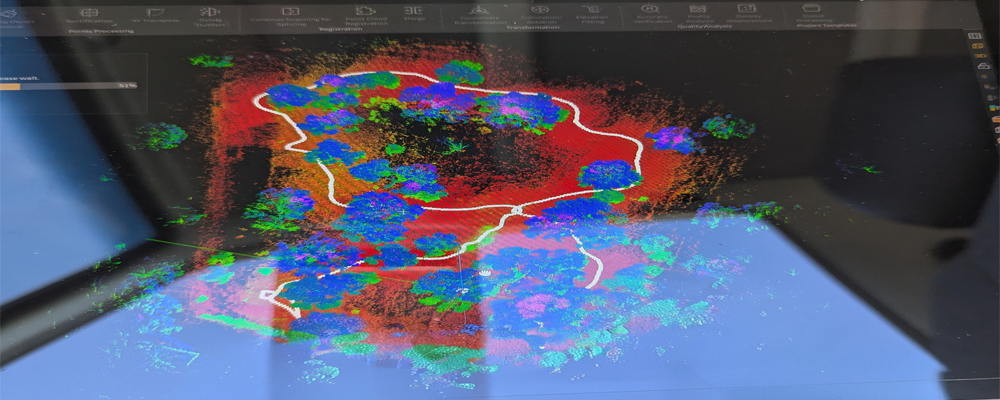
Professional And LiDAR surveys delivered with survey-grade accuracy, industry compliance, and flexible data delivery options.

Our LiDAR Equipment

Storm Spatial’s primary aerial LiDAR platform is the DJI M400 drone equipped with the L3 LiDAR payload — a professional-grade system capable of capturing high-density point cloud data with canopy penetration, multi-return processing, and the precision required for survey-grade terrain modelling.
For ground-based detail, our team deploys handheld LiDAR scanners and Robotic Total Stations to fill areas the drone cannot cover and to provide critical ground-truth verification.
Operating under our REOC (Remotely Piloted Aircraft Operator’s Certificate) certification, we can plan and execute flights in complex environments — including EVLOS (Extended Visual Line of Sight) operations for large survey areas, near aerodromes, agricultural corridors, and night operations where required — in full compliance with CASA regulations.

Compliance & Quality Standards

Storm Spatial’s LiDAR survey work is delivered in compliance with the applicable Australian and international standards:

  • ICSM LiDAR Guidelines v2.0 — the Intergovernmental Committee on Surveying and Mapping standard governing point density, accuracy classification, and data product specifications for LiDAR surveys in Australia
  • ASPRS Positional Accuracy Standards for Digital Geospatial Data (2023 or later) — the internationally recognised benchmark for horizontal and vertical positional accuracy of geospatial products
  • Surveying and Mapping Infrastructure Regulation 2014 (Vic) — or the relevant State equivalent for projects in other jurisdictions

For projects requiring formal quality assurance documentation, we provide a QA/QC report confirming compliance, completeness, and classification accuracy of the delivered point cloud and derived products. This is standard practice for government, council, and infrastructure contracts.

Output Formats

We deliver your survey data in the format your team already works with. Standard outputs include GIS layers, 2D and 3D DWG/DXF, 12D models, Pix4D project files, LAZ/LAS point clouds, GeoTiff rasters, and PDF drawings and reports. If your workflow requires a specific format, ask us.

Cloud-Based Data Access
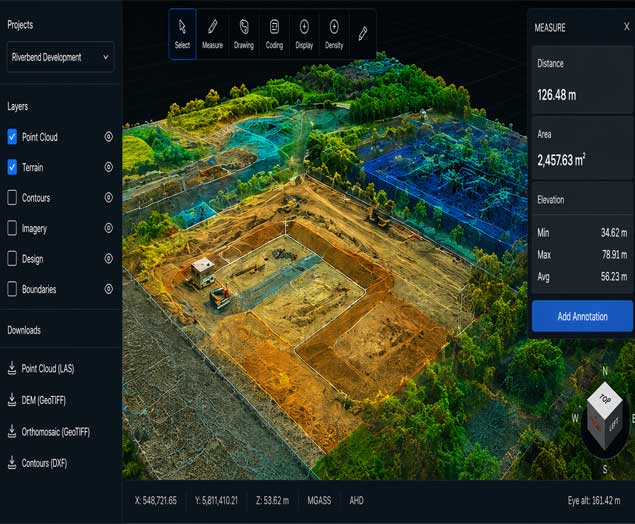
All clients receive access to our user-friendly cloud platform for viewing, downloading, and sharing project data in 3D. No specialist software required. We provide a walkthrough session to ensure your team can navigate and extract value from your survey data independently — because data you can’t use confidently isn’t delivering its full value.

A Note on Long Grass and Dense Vegetation

Honest Advice on LiDAR in Long Grass — What You Need to Know

LiDAR is exceptional technology — but we believe in being upfront about where its limitations can affect your results. Dense or long grass is a genuine challenge for any airborne LiDAR system, including our DJI M400 with L3 payload. Even with multi-return processing, long grass can partially obstruct ground returns, introducing variability in the bare-earth classification and affecting the precision of volume calculations and fine contour work.

We encounter this regularly on agricultural sites, undeveloped land, and rural properties across Victoria — and we’d rather discuss it honestly at the quoting stage than have it appear as a surprise in the data.

How We Address It

Option 1 — Mow Before We Fly
Our standard recommendation for sites with dense or long grass is simple: mow or slash the area before the flight. Even a single slasher pass removes the primary obstruction and significantly improves ground return quality. Where timing allows, this is the most cost-effective path to the best results.

Option 2 — Cross-Pattern Passes

Where mowing is impractical, our team can fly cross-pattern passes — covering the survey grid in two perpendicular directions — to maximise the probability of ground-hit returns beneath the canopy. This improves the bare-earth classification without requiring any site preparation.

Our Commitment at the Quoting Stage

We assess standard deviation from ground returns to true ground at the quoting stage and clearly communicate any expected impact on volume calculation accuracy before you commit. If the vegetation conditions at your site would compromise the accuracy requirements of your project, we’ll tell you — and recommend the best path forward. No surprises in the data.

Trusted by Councils, Contractors, Farmers & Developers Across Victoria

Storm Spatial has been delivering geospatial solutions since 2020, supporting clients across industries who share a common need: accurate, reliable ground data to make better decisions.

Civil Construction

Pre-construction topographic surveys, earthworks volumes, cut-and-fill analysis, and site monitoring throughout the build.

Agriculture

Farm drainage planning, precision land levelling, irrigation design, crop canopy analysis, and agricultural land mapping.

Land Developers

Planning permit surveys, subdivision design, lot levelling, and development feasibility data for residential and commercial projects.

Local Government & Councils

Infrastructure surveys, flood modelling, asset management data, road and drainage condition mapping, and GIS layer delivery.

Environmental Science

Habitat mapping, coastal erosion monitoring, wetland delineation, and environmental impact assessments.

Infrastructure & Engineering

Corridor surveys for roads, rail, and pipelines — large-area coverage with survey-grade accuracy delivered efficiently.

Why Industry Professionals Choose Storm Spatial for LiDAR Surveys

True Canopy-Penetrating LiDAR

Our DJI M400 with L3 payload reaches the actual ground surface beneath trees and crops — not just the canopy top. Essential for accurate DTMs on agricultural and forested sites.

Aerial and Ground Combined

We combine drone LiDAR with ground scanners, GPS, and Total Stations — tailoring the method to your site, not the other way around.

REOC Certified & CASA Compliant

Our REOC certification allows us to conduct EVLOS operations across large survey areas, operate near aerodromes, and conduct night flights — where uncertified operators cannot legally fly.

Recognised Compliance Standards

ICSM LiDAR Guidelines v2.0, ASPRS Positional Accuracy Standards (2023), and Surveying and Mapping Infrastructure Regulation 2014 (Vic) — with QA/QC reports available for government and council contracts.

Any Format, Any Platform

DWG, 12D, GIS, LAZ, GeoTiff, and more — plus cloud-based 3D viewing so every stakeholder can access and understand the data. No specialist software required.

Honest About Limitations

We assess long grass, dense vegetation, and other site conditions at the quoting stage and communicate any accuracy implications upfront. You get reliable results — or we tell you why before you commit.

Frequently Asked Questions

What is LiDAR drone surveying?
LiDAR (Light Detection and Ranging) drone surveying uses a laser scanning sensor mounted to an unmanned aerial vehicle (UAV) to measure the precise distance between the aircraft and the ground surface. The sensor fires millions of laser pulses per second and records the time each pulse takes to return, generating a dense 3D point cloud of the terrain. Unlike photography-based photogrammetry, LiDAR can penetrate vegetation canopies to reach the actual ground surface — making it uniquely effective for agricultural, forested, and complex terrain sites.
What is the difference between a DTM and a DSM?
A Digital Terrain Model (DTM) represents the bare-earth ground surface — with all vegetation, buildings, and above-ground objects removed from the data. A Digital Surface Model (DSM) represents everything the laser hits first, including tree canopies, rooftops, and structures. For civil engineering, drainage analysis, and land development, a DTM is typically required because it reflects the actual ground you’ll be building on or managing water across. Storm Spatial delivers both, depending on your project requirements.
How accurate is drone LiDAR surveying?
Drone LiDAR surveying with properly established ground control points (GCPs) can achieve horizontal and vertical accuracies in the range of 20–50mm under survey-grade conditions. Actual accuracy depends on flight parameters, GCP quality and distribution, terrain conditions, and the specific LiDAR system used. Storm Spatial’s DJI M400 with L3 payload, combined with GPS and Robotic Total Station ground control, delivers results referenced to MGA coordinates and the Australian Height Datum (AHD) — meeting the requirements of ICSM LiDAR Guidelines v2.0 and ASPRS Positional Accuracy Standards.
Can LiDAR penetrate tree canopies and crops?
Yes — this is one of the key advantages of LiDAR over photogrammetry. LiDAR systems emit multiple pulse returns per shot, meaning some pulses pass through gaps in the canopy and return a ground hit. This allows Storm Spatial to generate accurate bare-earth DTMs even on heavily vegetated or cropped sites. For particularly dense canopies, ground-based LiDAR scanning or GPS survey can supplement aerial data in critical areas. Note that long or dense grass presents specific challenges — see the Long Grass Advisory section above for our honest assessment and recommended approach.
Does long grass affect LiDAR accuracy?
Yes, and we think it’s important to be upfront about this. Dense or long grass is a genuine challenge for airborne LiDAR, including our DJI M400 and L3 system. Long grass can absorb or deflect laser returns before they reach the true ground surface, reducing the density of accurate ground-hit points and introducing variability into bare-earth classification. The practical effect is that volume calculations and precise contours in heavily grassed areas may carry a higher standard deviation than those on clear or mown ground. Our standard recommendation is to mow or slash the area before the flight where possible. Where that’s not practical, we can fly cross-pattern passes to maximise ground returns. We discuss site conditions and expected accuracy implications at the quoting stage — no surprises in the data.
What is REOC certification and why does it matter?
REOC (Remotely Piloted Aircraft Operator’s Certificate) is the highest level of drone operator certification available in Australia, issued by CASA (Civil Aviation Safety Authority). It allows Storm Spatial to operate in complex and restricted environments — including controlled airspace, near aerodromes, over populated areas, and at night — where uncertified operators cannot legally fly. For government, council, and infrastructure projects in particular, working with a REOC-certified operator ensures legal compliance and eliminates project risk from regulatory non-compliance.
What compliance standards do you work to?
Storm Spatial’s LiDAR survey work is delivered in compliance with ICSM LiDAR Guidelines v2.0 (the Australian national standard for LiDAR data collection and classification), ASPRS Positional Accuracy Standards for Digital Geospatial Data (2023 or later), and the Surveying and Mapping Infrastructure Regulation 2014 (Vic) or relevant State equivalent. For projects requiring formal quality assurance, we provide a QA/QC report confirming compliance, completeness, and classification accuracy of the delivered point cloud and derived products.
What areas of Victoria do you service?
Storm Spatial is based in Geelong and services projects across Victoria, including the greater Melbourne metropolitan area, the Surf Coast, Bellarine Peninsula, Macedon Ranges, Western Victoria, and regional areas statewide. For large projects or remote sites, contact us to discuss mobilisation.
What data formats do you deliver?
We deliver survey data in a wide range of formats to suit your workflow: GIS layers (Shapefile, GeoPackage), 2D and 3D DWG/DXF (AutoCAD), 12D models, Pix4D project files, LAZ/LAS point clouds, GeoTiff rasters, and PDF drawings and reports. All elevations are provided on the Australian Height Datum (AHD) unless a localised datum is specified. All clients also receive access to our cloud-based 3D viewing platform for sharing and navigating project data without specialist software.

Ready to Get Survey-Grade Terrain Data for Your Project?

Whether you need a topographic survey, flood model, agricultural land analysis, or a large-scale infrastructure survey, Storm Spatial has the technology, certification, and expertise to deliver — across Geelong, Melbourne, and Victoria.
Contact us today for a fast, no-obligation quote. Tell us about your site and we’ll recommend the best approach.
info@stormspatial.com.au | Geelong, Victoria | Servicing Victoria-Wide