
Drone LiDAR Surveys & Terrain Modelling Across Victoria
Survey-grade ground and terrain data — delivered faster than traditional methods.
From civil construction and land development to agriculture, flood modelling, and environmental assessment, we provide the terrain intelligence your project needs to move forward with confidence.

REOC Certified Drone Operations

Survey-Grade Accuracy

AHD & MGA Compliant Outputs

Geelong-Based, Victoria-Wide
Better Ground Data. Less Time on Site. More Confident Decisions.
LiDAR-equipped drones change the equation entirely. Our aerial systems capture millions of precise elevation measurements per second, penetrating crop canopies and tree cover to reach the actual ground surface. The result is a dense, accurate point cloud that can be processed into a true Digital Terrain Model (DTM), contour map, or drainage analysis — delivered in days, not weeks.
For civil engineers, developers, councils, and landowners across Victoria, this means faster feasibility assessments, more reliable design inputs, and better decisions — at a lower total project cost.
Traditional Survey
LiDAR Drone Survey
Timeframe
Accuracy
Area Coverage
Timeframe
Accuracy
Area Coverage
Traditional Survey
Timeframe
Accuracy
Area Coverage
LiDAR Drone Survey
Timeframe
Accuracy
Area Coverage
Terrain Intelligence for Every Project Type

Topographic & Terrain Surveys

Drainage & Waterflow Analysis

Construction Monitoring & Mapping

Land Development Planning

Agricultural Mapping

Environmental & Heritage Surveys

Infrastructure & Transport Surveys

GIS Layers & Asset Management
From Site Brief to Delivered Data — Here’s How It Works

Project Consultation
Aerial & Ground Data Capture

Processing, Drafting & Delivery
Advanced LiDAR Technology. Recognised Standards. Flexible Outputs.
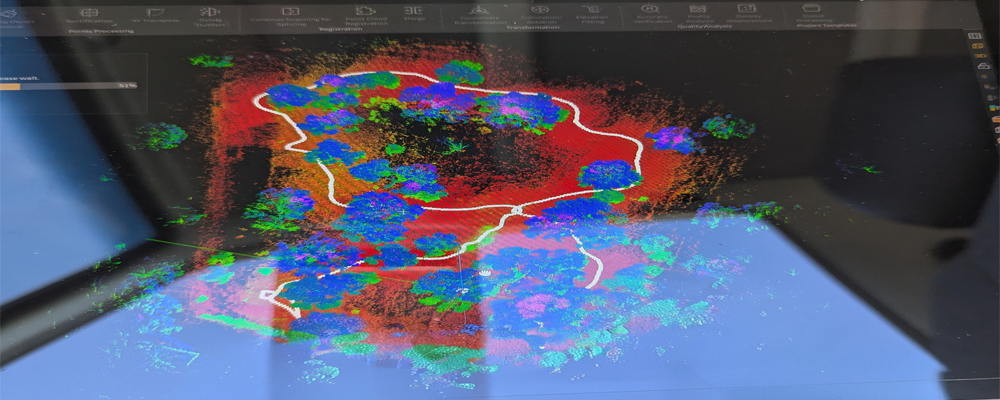
Our LiDAR Equipment
For ground-based detail, our team deploys handheld LiDAR scanners and Robotic Total Stations to fill areas the drone cannot cover and to provide critical ground-truth verification.
Compliance & Quality Standards
Storm Spatial’s LiDAR survey work is delivered in compliance with the applicable Australian and international standards:
- ICSM LiDAR Guidelines v2.0 — the Intergovernmental Committee on Surveying and Mapping standard governing point density, accuracy classification, and data product specifications for LiDAR surveys in Australia
- ASPRS Positional Accuracy Standards for Digital Geospatial Data (2023 or later) — the internationally recognised benchmark for horizontal and vertical positional accuracy of geospatial products
- Surveying and Mapping Infrastructure Regulation 2014 (Vic) — or the relevant State equivalent for projects in other jurisdictions
For projects requiring formal quality assurance documentation, we provide a QA/QC report confirming compliance, completeness, and classification accuracy of the delivered point cloud and derived products. This is standard practice for government, council, and infrastructure contracts.
Output Formats
We deliver your survey data in the format your team already works with. Standard outputs include GIS layers, 2D and 3D DWG/DXF, 12D models, Pix4D project files, LAZ/LAS point clouds, GeoTiff rasters, and PDF drawings and reports. If your workflow requires a specific format, ask us.
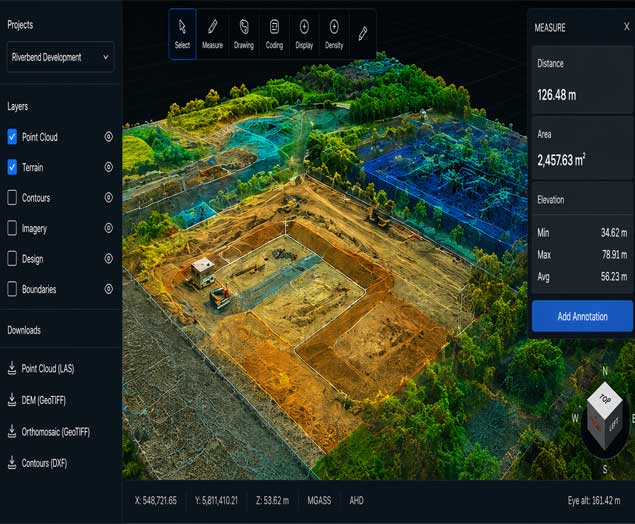
Cloud-Based Data Access
A Note on Long Grass and Dense Vegetation
Honest Advice on LiDAR in Long Grass — What You Need to Know
LiDAR is exceptional technology — but we believe in being upfront about where its limitations can affect your results. Dense or long grass is a genuine challenge for any airborne LiDAR system, including our DJI M400 with L3 payload. Even with multi-return processing, long grass can partially obstruct ground returns, introducing variability in the bare-earth classification and affecting the precision of volume calculations and fine contour work.
How We Address It
Option 1 — Mow Before We Fly
Option 2 — Cross-Pattern Passes
Our Commitment at the Quoting Stage
We assess standard deviation from ground returns to true ground at the quoting stage and clearly communicate any expected impact on volume calculation accuracy before you commit. If the vegetation conditions at your site would compromise the accuracy requirements of your project, we’ll tell you — and recommend the best path forward. No surprises in the data.
Trusted by Councils, Contractors, Farmers & Developers Across Victoria
Civil Construction
Agriculture
Land Developers
Local Government & Councils
Environmental Science
Infrastructure & Engineering
Why Industry Professionals Choose Storm Spatial for LiDAR Surveys
True Canopy-Penetrating LiDAR
Our DJI M400 with L3 payload reaches the actual ground surface beneath trees and crops — not just the canopy top. Essential for accurate DTMs on agricultural and forested sites.
Aerial and Ground Combined
REOC Certified & CASA Compliant
Recognised Compliance Standards
Any Format, Any Platform
Honest About Limitations
Frequently Asked Questions
What is LiDAR drone surveying?
LiDAR (Light Detection and Ranging) drone surveying uses a laser scanning sensor mounted to an unmanned aerial vehicle (UAV) to measure the precise distance between the aircraft and the ground surface. The sensor fires millions of laser pulses per second and records the time each pulse takes to return, generating a dense 3D point cloud of the terrain. Unlike photography-based photogrammetry, LiDAR can penetrate vegetation canopies to reach the actual ground surface — making it uniquely effective for agricultural, forested, and complex terrain sites.
What is the difference between a DTM and a DSM?
How accurate is drone LiDAR surveying?
Can LiDAR penetrate tree canopies and crops?
Does long grass affect LiDAR accuracy?
What is REOC certification and why does it matter?
What compliance standards do you work to?
What areas of Victoria do you service?
What data formats do you deliver?
Ready to Get Survey-Grade Terrain Data for Your Project?
Contact us today for a fast, no-obligation quote. Tell us about your site and we’ll recommend the best approach.